


ROBOTIC MEN | Villa Brentano
ROBOTIC MEN
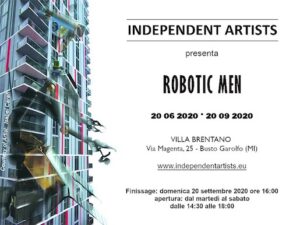
20 GIUGNO 2020 - 20 SETTEMBRE 2020 | JUNE 20, 2020 - SEPTEMBER 20 , 2020
VILLA BRENTANO
A cura di Manuel Zoia | Curated by Manuel Zoia
Richard Ansett Roberta Astegiano, Piero Bagolini Silvia Beltrami Stefano Bonazzi Angelo Brugnera Isabel Carafì Luca Casonato Filiberto Crosa Giulio D’Amico Enrico Dal Fiume Lele De Bonis Raffaele Dragani Bruno Larini Paolo Manganelli Myles Mansfield Gian Luigi Martelli Mauro Martin Angelo Demitri Morandini Marzia Mucchietto Ada Nori Thomas Pacher Bianca Passaglia Andrea Sbra Perego Francesca Pompei Luciano Puzzo Antonella Serratore Rosaria Stevenazzi Mario Sughi Francesco Trovato Urbano Solido Angela Vinci Tommaso Maurizio Vitale Alice Voglino Mayumi Yamakawa Roberto Ziranu
Title
Con l’invito alla presente collettiva Independent Artists intende proporre un ragionamento sui temi che riguardano la robotica
Davanti alla crescente automazione dei processi si apre infatti una grande sfida per l’umanità: come è possibile realizzare un mondo in cui l’automazione riflette e sostiene i nostri valori? In un futuro non molto lontano da noi coabiteremo e collaboreremo con macchine automatiche progettate per migliorare il nostro vivere quotidiano. Tutto ciò comporta il fatto di dover affrontare nuovi problemi che riguardano l’etica, la psicologia, l’ambito sociale ed economico. Il pensiero filosofico si sta già muovendo nella direzione di un ragionamento sul rapporto tra macchine e umanità. Molto spesso infatti i robot non sono più intesi come “protesi” dell’uomo, ma sostituti veri e propri della sua presenza e del suo lavoro. In linea di principio ciò che interessa il ragionamento filosofico è la relazione di questi congegni con gli esseri viventi. Gli esseri umani sono identificati dalle capacità di progettazione, dall’aprirsi a nuove situazioni trovando risposte intelligenti alle immediate emergenze singole e della collettività. Anche l’Arte molto spesso si è interessata a questi argomenti. Nel caso di Mellone lo dimostrano anche le Figure biomorfe (1971,72), sculture realizzate con cavetti di plastica rosa che ricordano le composizioni “morbide” antiform di Eva Hesse e presentano pochi paralleli in Italia. Certamente l’interesse dell’Arte Contemporanea per il fenomeno della robotica è tuttora attivo e in fermento: nell’estate 2018 al Grand Palais di Parigi una trentina di artisti contemporanei sono stati radunati dallo storico dell’arte Laurence Bertrand Dorléac insieme a Jérôme Neutres per raccontare l’affascinante rapporto tra uomo e macchina. La presente collettiva vuole essere al contempo un omaggio al lavoro del Maestro e uno sprone per gli Artisti contemporanei a studiare e approfondire le medesime tematiche che hanno affascinato Dario Mellone durante gli anni della sua fervente e meticolosa attività artistica. Lanciamo così la nostra proposta tematica citando uno dei più grandi scrittori di fantascienza e tra i più ineguagliati divulgatori scientifici del mondo, Isaac Asimov: “Qualsiasi innovazione tecnologica può essere pericolosa: il fuoco lo è stato fin dal principio, e il linguaggio ancor di più; si può dire che entrambi siano ancora pericolosi al giorno d’oggi, ma nessun uomo potrebbe dirsi tale senza il fuoco e senza la parola”.
With the invitation to this collective Independent Artists intends to propose a reasoning on the issues that concern robotics. Faced with the growing automation of processes, a great challenge for humanity opens up: how is it possible to create a world in which automation reflects and sustains our values? In a future not far from us we will cohabit and collaborate with automatic machines designed to improve our daily lives. All this entails having to face new problems concerning ethics, psychology, the social and economic sphere. Philosophical thought is already moving in the direction of a reasoning on the relationship between machines and humanity. In fact, very often robots are no longer intended as man’s “prosthesis”, but real substitutes for his presence and his work. In principle, what concerns philosophical reasoning is the relationship of these devices with living beings. Human beings are identified by their design skills, by opening up to new situations by finding intelligent answers to immediate individual and collective emergencies. Art also very often took an interest in these topics. In the case of Mellone, the biomorphic figures (1971,72) also demonstrate this, sculptures made with pink plastic cables that recall Eva Hesse’s “soft” antiform compositions and have few parallels in Italy. Certainly the interest of Contemporary Art for the phenomenon of robotics is still active and in turmoil: in the summer of 2018 at the Grand Palais in Paris about thirty contemporary artists were gathered by the art historian Laurence Bertrand Dorléac together with Jérôme Neutres to tell the fascinating relationship between man and machine. The present collective wants to be at the same time a tribute to the work of the Maestro and a spur for contemporary artists to study and deepen the same themes that have fascinated Dario Mellone during the years of his fervent and meticulous artistic activity. So we launch our thematic proposal by citing one of the greatest science fiction writers and among the most unmatched scientific communicators in the world, Isaac Asimov: “Any technological innovation can be dangerous: fire has been from the beginning, and language even more; it can be said that both are still dangerous today, but no man could be said to be such without fire and without speech ”.
Con il patrocinio della Fondazione Dario Mellone | Under the patronage of Fondazione Dario Mellone
VILLA BRENTANO
VIA MAGENTA, 25,
BUSTO GAROLFO (MI)
